
You Are Not Behind

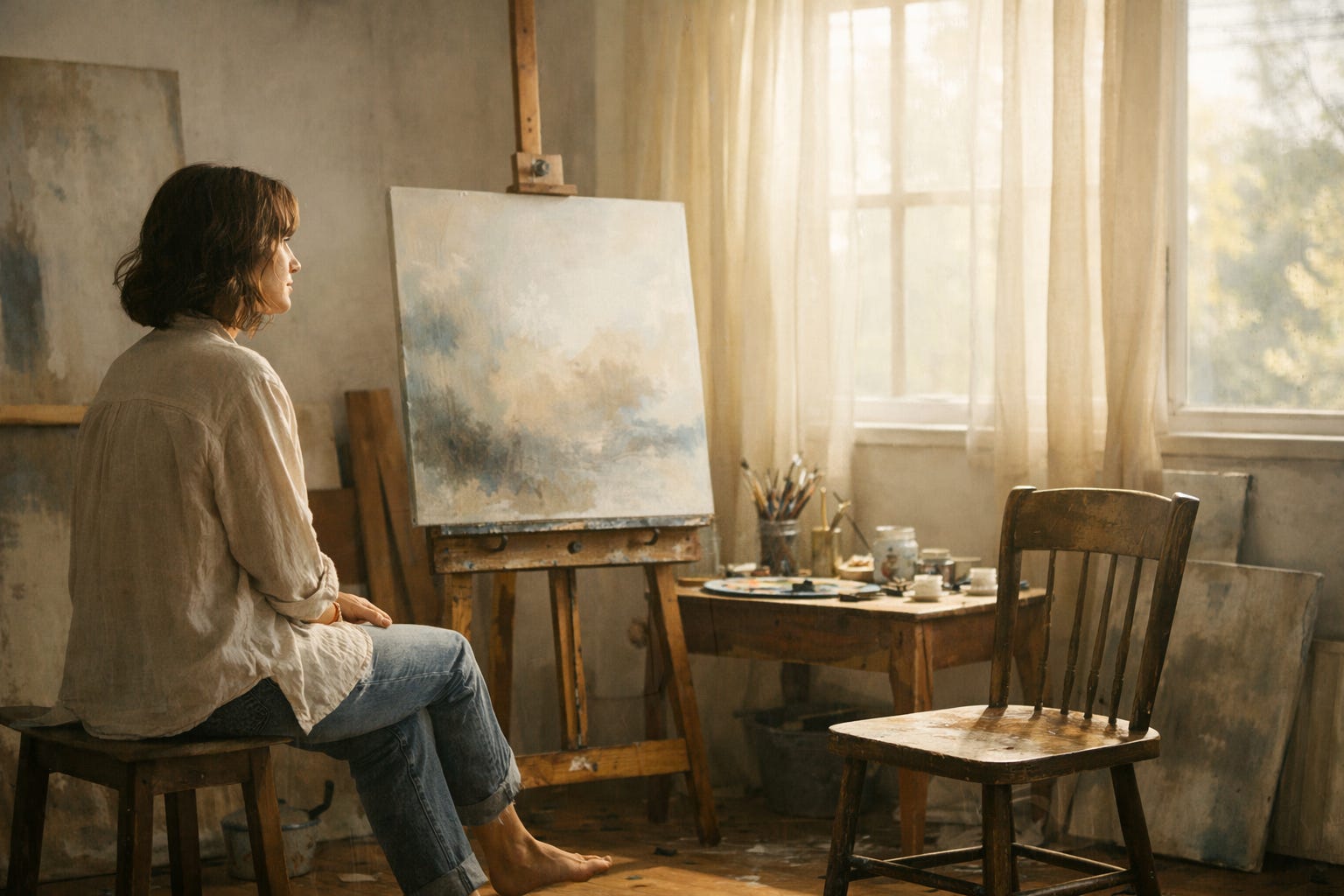
For creatives, the feeling of being “behind” rarely comes from a lack of effort. It usually comes from measuring ourselves against inherited ideas of success that were never humane to begin with.
We are surrounded by ideas about speed, output, and visibility that shape how we come to visualize success. Publish four books a year. Build an audience by thirty. Hit a list by forty. Art should justify itself financially. Over time, these ideas begin to feel real, even though they were built for systems that value efficiency more than joy. More than the strength of our creative spark.
When you measure courage and creativity against the wrong timelines, steadiness can be mistaken for slowness, and care can feel like failure.
But creative lives have never worked that way.
If you feel behind, it’s rarely because you have failed to move. More often, it’s because you have been measuring yourself against a pace that was never designed for you in the first place.
You are not behind.
You are moving on a timeline shaped by reality.
The Myth of the Universal Pace
Much of the pressure creatives feel comes from external rhythms. The speed of platforms. The visibility of other people’s milestones. The impression that progress happens in a straight line, uninterrupted by detours or pauses.
These rhythms are loud, but they are not neutral.
They’re built around systems that reward consistency, speed, and output, often without regard for the complexity of real lives. When you absorb these expectations without questioning them, it becomes easy to believe that any deviation means you are falling behind.
But life isn’t linear, and neither is creativity.
Most creative paths include seasons of acceleration and seasons of stillness. They include periods of focus and periods of fragmentation. They include interruptions, responsibilities, and changes that reshape what progress looks like from the inside.
None of this is a failure of discipline. It is the texture of living.
Nonlinear Lives, Real Progress
Illness, caregiving, loss, financial shifts, and unexpected obligations are often treated as explanations that require apology. As if a creative life must justify its own pauses. As if these things never happen to creatives.
But these seasons are not detours away from your path. They’re part of it.
And they’re absolutely not something to apologize for. These things are life, the very heart and energy of what fuels creatives.
A creative life isn’t a straight road with predictable milestones. It’s more like a dance, shaped by changing music, changing partners, and changing ground beneath your feet. Sometimes you move quickly. Sometimes you adjust. Sometimes you rest and listen for the rhythm to return.
Progress doesn’t disappear during these seasons. It changes form.
Skills deepen. Perspective expands. Values clarify. Even when output slows, something essential is still being built deep within.
Recognizing this allows you to stop arguing with reality and begin working with it.
Trusting the Pace That Feeds You
Sometimes, when we are feeding our creative spark, it may appear that forward progress has stalled. It is all too easy to interpret that pause as a threat to success or a sign of weakness. But what if success isn’t necessarily marked by productivity but by how well-fed our creativity is?
When your pace supports your creativity, you feel steadier. You recover more quickly from setbacks. You experience moments of satisfaction rather than constant depletion. Joy doesn’t vanish the moment you stop producing.
This doesn’t mean the work is always easy or pleasant. It means the work feels aligned with your capacity and your values.
Learning to trust this internal feedback is an act of empowerment. It allows you to make decisions based on what actually sustains you, rather than what appears impressive from the outside.
You are not required to match anyone else’s speed in order to move forward meaningfully.
Stability in a Shifting World
The world around you will continue to change. Timelines will compress and expand. New tools will appear. Old structures will dissolve. The sense of urgency may never fully disappear.
Stability doesn’t come from keeping up with all of it.
Stability comes from knowing your own rhythm and returning to it when the noise grows loud. It comes from recognizing that the creative life isn’t something to be rushed through with one eye on output, but something to be lived with intention, something to be treasured and fed.
When you stop treating progress as a race, you regain agency. You are no longer reacting to pressure. You are choosing direction.
And that choice is powerful.
Standing Where You Are
Where you are right now isn’t a problem to solve.
It is a place to stand.
From here, you can move forward with clarity instead of urgency. You can take steps that fit your energy instead of borrowing momentum from stress. You can allow joy to orient you toward what matters, rather than using it as a reward you earn later.
You are not behind.
You are grounded.
You are capable of choosing your own pace in a world that rarely slows down.
And that steadiness is exactly what allows real progress to continue.
Reflection Prompts
Where have you felt pressure to match a timeline that doesn’t fit your life?
What signs tell you when your creative pace is nourishing rather than draining?
How might viewing your life as a dance between productivity and recharging phases change the way you interpret pauses or slow seasons?
What does empowerment feel like when you trust your own rhythm?
You are not late to your life.
You are right where your next step can begin.
This post is part of The Work of Joy, my current non-fiction project. You can preorder the full epub here.
Want to go deeper? Check out my interactive class, It’s a Wonderful Writer’s Life.
Thank you. One of the things I have to keep in mind is that medical treatment is a major life event. In my case, it's a major life event playing out over the course of a year. I've heard stories of other writers basically writing their way through treatment, and I've had to give myself grace in that maybe that doesn't apply to me. Even more so ... I've had to accept that it's okay.
Yes, to be read slowly, more than once, and thought over.
There is so much writing advice out there, and much of it is very good, but it can breed a sense of constant urgency, and of the danger of being left behind. Time is on your side when you are younger, but gradually and imperceptibly it becomes your enemy. Your publishing goals need to change, including any online presence. Maybe your creativity is for you and a small circle around you, and it never was going to be any wider than that. And maybe your task now is to hone your skills with that in mind, and find contentment in it.