

Note: this is not part of the series “Reflections from the Mirror” series. Just a side note I couldn’t resist sharing.
When you’re working on a piece of writing, sometimes everything just feels off. Jarring. Disconnected. Then something shifts.
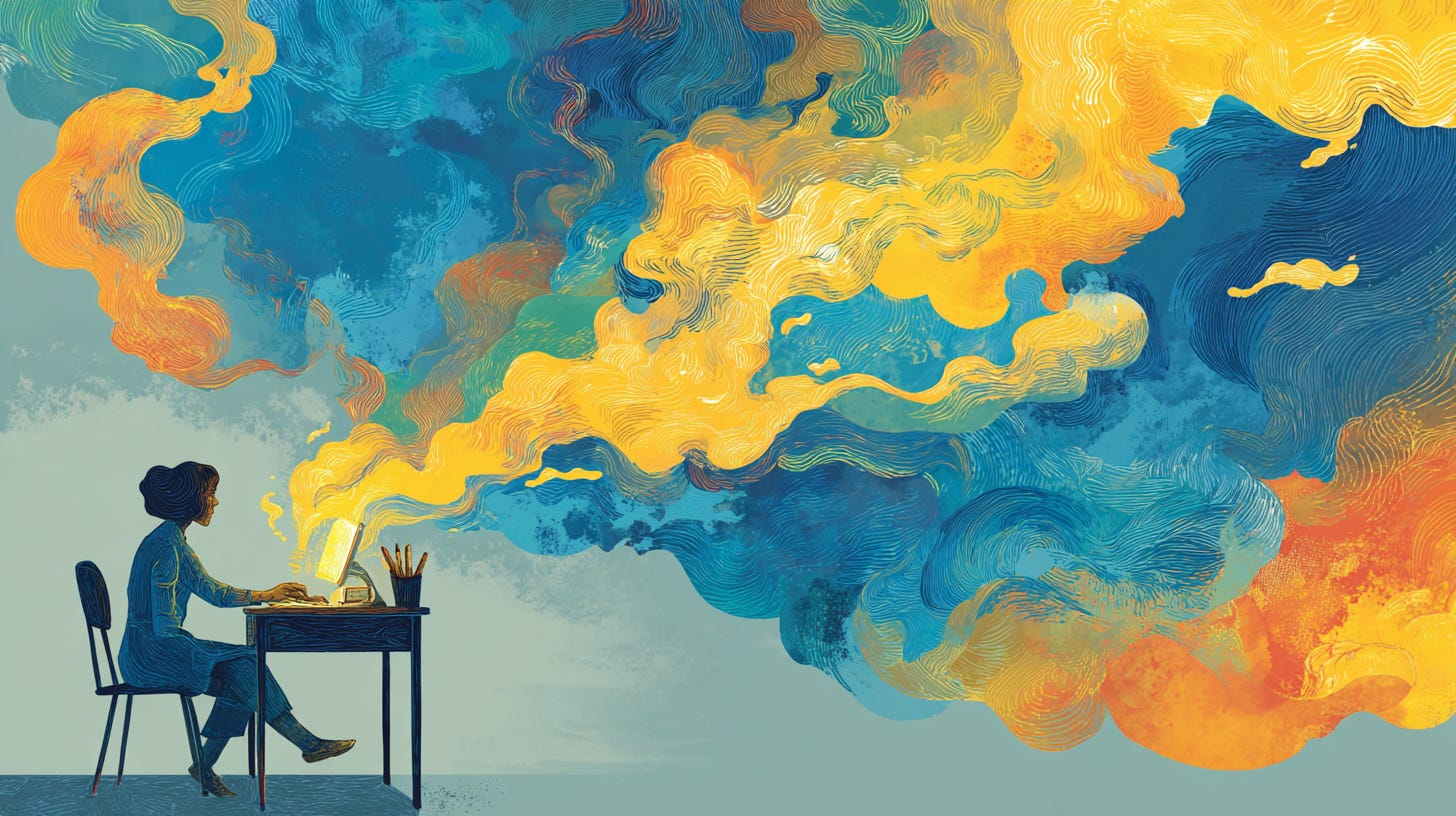
As you edit and move forward, the piece begins to hum. The structure settles. The voice aligns. A kind of resonance emerges, a vibe that gives you chills as you write. You’re in flow. Words fall onto the page. There's that moment of lift, like catching a thermal. That’s the magic.
This is the space where writers sometimes come back and realize… the words never actually made it onto the page. Bits were lost in the typing, as your creative heart chased a vision your fingers couldn’t quite catch.
Recently, I came across a fascinating idea from the tech world: vibe coding.
Computer programmers have begun to use the term “vibe coding” for a powerful method they use when coding with the help of AI. You can read about it here: https://cloud.google.com/discover/what-is-vibe-coding
Essentially, they’re getting to the heart of the code. Instead of focusing on perfect syntax or best practices, they prioritize flow, feeling, and momentum. Less formula. More instinct. Less rigidity. More life.
And I thought... why not apply this to writing?
I’d like to officially coin the term: vibe writing. (If no one has done it yet!)
For me, coding has often felt like a creative act. When I spend a day coding, I find my writing energy has been drained as if I’d spent the day writing and editing. The two skills feel related.
Vibe Coding vs. Vibe Writing
Here’s how I think vibe writing could compare with vibe coding:

In both cases, the creator is guided by a vibe. A sensory-emotional response that leads the next move, even when it makes no rational sense. You’re not following a recipe. You’re tuning into resonance.
Writers shape sentences not just by structure, but by energy. Tone. Rhythm. We follow the feel of the words as much as their meanings.
Lately, I’ve been experimenting with different ways that writers might work with AI. No, not in the way of “get rich quick, turn out a ton of books” but in helping to take off some of the cognitive load so that we can write more creatively.
When AI takes on the scaffolding of the outlines, the summaries, the repetitive tweaks, it frees up mental space. And in that space, creativity returns. Stories breathe again.
What began as an experiment for my students has grown into a process that feels more empowered and more honest. That’s how the Reflections from the Mirror series began. (And for the record, it is not all pro-AI. It's just human. Curious. Cautious. Open.)
Have you ever heard the term “vibe writing” before?
If yes, let me know where. Maybe it’s already out there. Maybe it’s just waiting for a name.
If not, want to help me spread it?
Comments are open on this post as a test. I’d love to hear your thoughts, especially if you’ve ever felt that rhythm shift in your own writing.
I called it vibe substacking but yours is more accurate. I completely feel and understand what you wanted to say and that's my vibe too ..
Sometimes writing is easy; sometimes writing is hard. 'Vibe Writing' happens when it's easy; don't know what to call the hard, though. And then sometimes it's medium.
It's a good term.